
Power per pitch. Kilowatt hours on the right booking.
A fixed power charge per night comes out wrong in both directions: the motorhome with electric heating pays too little and the tent too much. With power per pitch, what the guest actually uses is metered, hour by hour, and the consumption lands on the right booking without anyone reading a meter.
The same night, three pitches. Three completely different bills.
44.7 kWh
pitch 9 today: a motorhome with electric heating, second night of four
- Pitch 17 today, caravan
- 25.5 kWh
- Pitch 14 today, tent without power
- 0 kWh
- Pitch 9 since arrival yesterday
- 61.5 kWh
Measured at 21:16 in the demo's day. Strandvik is a made-up campsite.
The power belongs to the booking. Not to a note in the reception.
With a fixed charge all three would have paid the same. With metering per pitch each pays for their own, and you see what the power actually cost you that night.
The meter reading belongs to the booking on the pitch, not to the power post. If the guest moves to another pitch the consumption follows the booking, and the figures still agree.
- Pitch 17 today
- 25.5 kWh
- Since arrival
- 36.3 kWh
- The metering
- per pitch, per hour
This is an interactive demo of Revelius: the guest's phone for pitch 17, where you can pay. Everything works with the keyboard.
Demo data. Strandvik is made up, and nothing you do is saved.The full demo is on the front page
The metering and the money. Two sides of the same power post.
The metering
Every pitch has its own metering point, and the consumption is counted hour by hour without anyone walking round reading meters. The guest sees their kilowatt hours on the phone, on the same page as the booking, and you see them in the overview and in the figures.
The socket and the money
The power post opens the socket once the guest has checked in and paid, and the consumption is put on the booking and paid by card or Swish. The socket, the metering and the payment are the same power post seen from three sides.
The pitches as dusk falls. Every power post has its state.
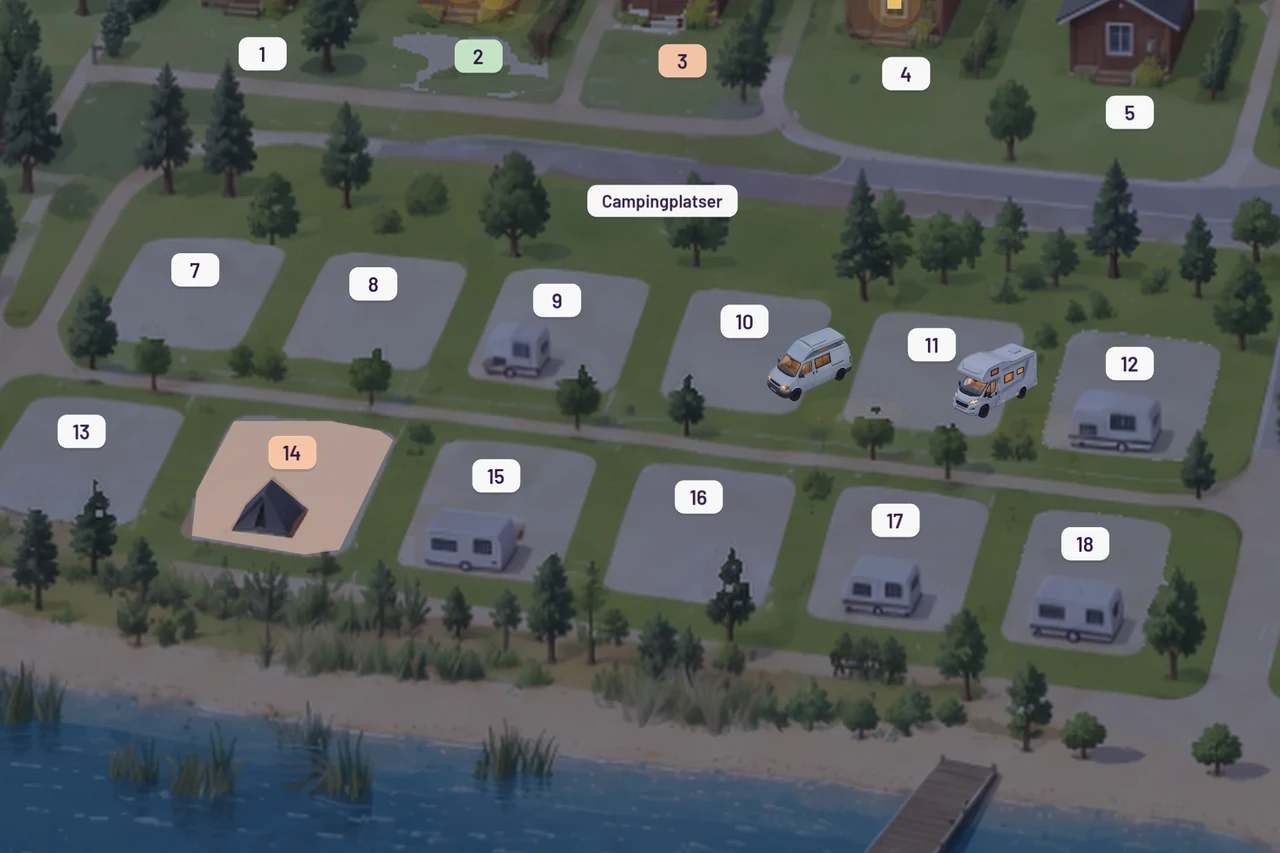
- Pitch 9
- 61.5 kWh since arrival, second night of four
- Pitch 17
- 25.5 kWh today, 36.3 since arrival
- Pitch 14
- tent pitch without power, 0 kWh
- The post between two pitches
- one metering point per pitch, one state per socket
An internal power network within a campsite needs no grid concession, see internal network. Whether the power is charged as a fixed fee or by consumption affects how the VAT is to be handled, and that is a question for your accountant.
Questions about the power. Permits, posts and consumption.
Do I need a permit to sell power to the guests?
An internal network within a campsite or a similar area for leisure activities is exempt from the grid concession requirement under IKN-förordningen (the regulation on networks exempt from concession). Ask your electrical installer about your own network.
Do I have to replace all the power posts?
It depends on what is there today. Which posts can meter and which need replacing we go through at the mapping.
What happens if a guest draws more power than they have paid for?
The consumption keeps counting on the booking, and the difference shows in the overview. You decide whether the socket should be closed or the guest should pay afterwards.
Does the guest see their own consumption?
Yes, on the phone, on the same page as the booking. The guest sees kilowatt hours and what they come to in kronor.
Does it work for cabins and single rooms?
Yes. A metering point is a metering point, whether it sits on a post at a pitch or in a cabin.
In the same system
Features
- Campsites and motorhome stopsPitches, bookings, staff and payment in one system for campsites, motorhome stops and farm campsites. No double booking, card and Swish tied to the booking, power per kWh and the campsite as a living map.
- Map and premisesPitches, cabins and buildings on a map you draw yourself, in the same colours as the state: checked in, unpaid, free. The same data is also drawn as a living world.
- Self check-inThe guest checks in with a QR code at the pitch, sees their pitch and pays by card or Swish. You see the arrival in the overview.
- Internal networkAn internal network within a campsite is exempt from the requirement for a network concession under Section 16 of IKN-förordningen. What the exemption covers, and what it does not answer.
Every kilowatt hour on the right pitch. The mapping starts at the posts.
At the mapping we go through the posts, the metering and how the power is to be charged at your place.
Book a callRevelius is a product of Tavus Sweden AB, Stockholm.