
The owner's overview. The state of things in one sentence.
The first thing you see in the morning and the last thing you see in the evening is a sentence. It says how things stand and whether anything needs you. Below it stand the figures, always with a denominator and a time, and below them what is actually waiting for a decision.
One sentence first. Then the figures, with denominator and time.
The report line is rewritten every time something happens: a booking comes in, a payment lands, a guest checks in. At 21:16 at Strandvik it says that nine of twelve pitches are taken tonight, that pitch 10 is arriving, that pitch 14 has not paid and that three vehicles leave tomorrow. If nothing needs you, the line says that too, in words.
Below the line stand the figures with their denominators, and below them a queue with what is waiting: the unpaid pitch, the arrival that has not turned up, the shift tomorrow that is short of someone. The queue is sorted by what happens first, not by when it was created.
The window below is the real overview with made-up data, not a picture of it. Click a row to open the panel for the pitch, switch tab, or press ⌘K and type a verb.
- Tonight
- 9 of 12 pitches
- Unpaid
- pitch 14 · 21:16
- The reception
- closed since 16
- Tomorrow
- 3 departures
This is an interactive demo of Revelius: the owner's overview for the campsite Strandvik, open at the owner's overview 21:16, with the tabs Today, Calendar, Place and Me, a panel for the selected pitch and the ⌘K search. Everything works with the keyboard.
Demo data. Strandvik is made up, and nothing you do is saved.Swipe inside the window to see more.The full demo is on the front page
Three o'clock, and half past eleven. The same figures, a new state of things.
At 15:00 six of twelve pitches are taken and pitch 18 is arriving. At 21:00 nine of twelve are taken, pitch 10 is arriving and two pitches have not paid. Fourteen minutes later pitch 11 pays and the line is rewritten again. At 23:30 nine of twelve are still taken, and a single pitch is unpaid.
None of the figures is a percentage, and none is an average. A figure without a denominator cannot be acted on: eight of twelve pitches is a state of things, 67 per cent is a feeling.
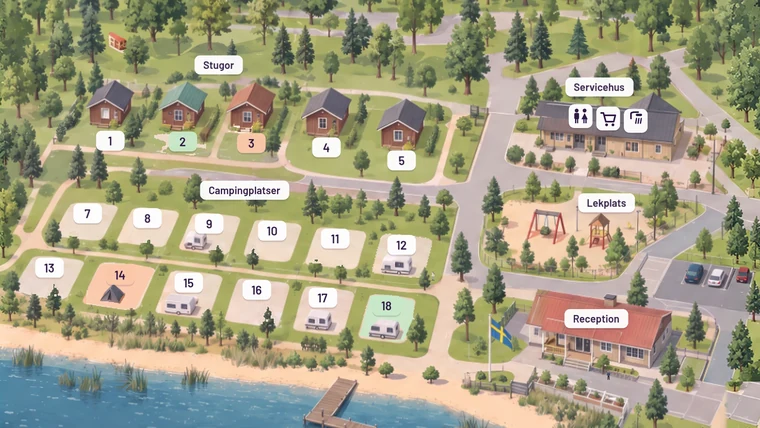
Six of twelve pitches. Pitch 18 is arriving, the reception staffed until 16.
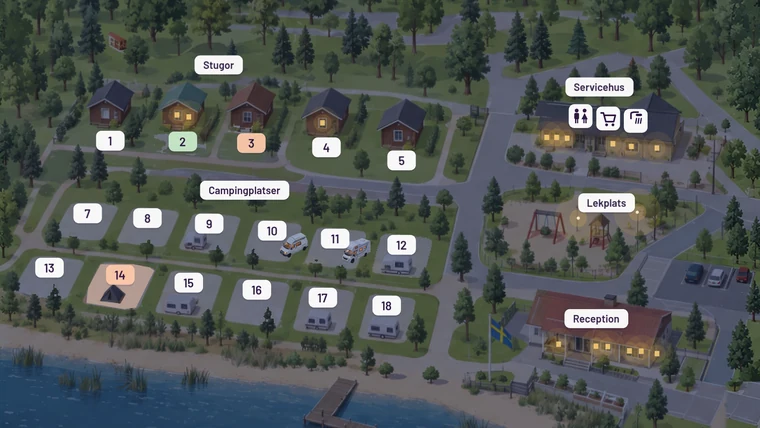
Nine of twelve pitches. Pitch 14 has not paid, and the windows are lit in five of them.
Six parts in the overview. The line, the figures, the queue and the search box.
- The report line: the state of things in one sentence, rewritten when something happens
- The figures for the night, arrivals, unpaid and departures, with denominators
- To do now: what is waiting for you, sorted by what happens first
- The panel for a pitch, at the same address for everyone allowed to see it
- The search box ⌘K: find a guest or do something straight away
- The same state of things on the phone, which speaks up only when something needs you
Six parts in one view, not six modules: they are written by the same event and show the same minute.
Why the figures always agree. They are counted in one place.
A booking that comes in on the web writes the calendar, the map, the staff phone and the owner's report line in the same second. No view recalculates on its own and no view takes its figure from another view, so there are never two answers to the same question.
Questions about the overview. The phone, the roles and the denominators.
Does the overview work on the phone?
Yes. The same state of things is on the phone, as an app you install straight from the web. The phone speaks up when something needs you, not every time something happens.
Who sees the overview?
The owner and those you give the role. The staff see their shift and their routines, the guest sees their booking. Neither of them sees the overview.
What does the denominator in the figures mean?
That every figure stands together with how many it is counted out of: nine of twelve pitches, one of twelve unpaid. A figure without a denominator cannot be used to make a decision.
Can I see the state of things back in time?
Every pitch and every booking has its history with times: when it was booked, when the guest arrived and when the payment landed.
What happens if two people look at the same time?
Both see the same state of things. The panel for a pitch has an address of its own, so it can be passed on and opens the same way for whoever receives the link.
In the same system
Features
- Map and premisesPitches, cabins and buildings on a map you draw yourself, in the same colours as the state: checked in, unpaid, free. The same data is also drawn as a living world.
- Bookings and calendarAll bookings in one calendar, per pitch, cabin, room or practitioner. The same pitch can never be booked twice, not even when two people book at the same time.
- PaymentsCard and Swish that belong to the booking they are for, so you see straight away who has paid for what, and reconciliation against the bank in your bookkeeping software.
- OwnerThe owner sees occupancy, what is unpaid and who is working, in one overview on the computer and on the phone. The phone speaks up only when something needs you.
The last thing you see in the evening. One sentence that says whether anything needs you.
At the mapping we decide which figures stand in your overview and what the report line should say.
Book a callRevelius is a product of Tavus Sweden AB, Stockholm.